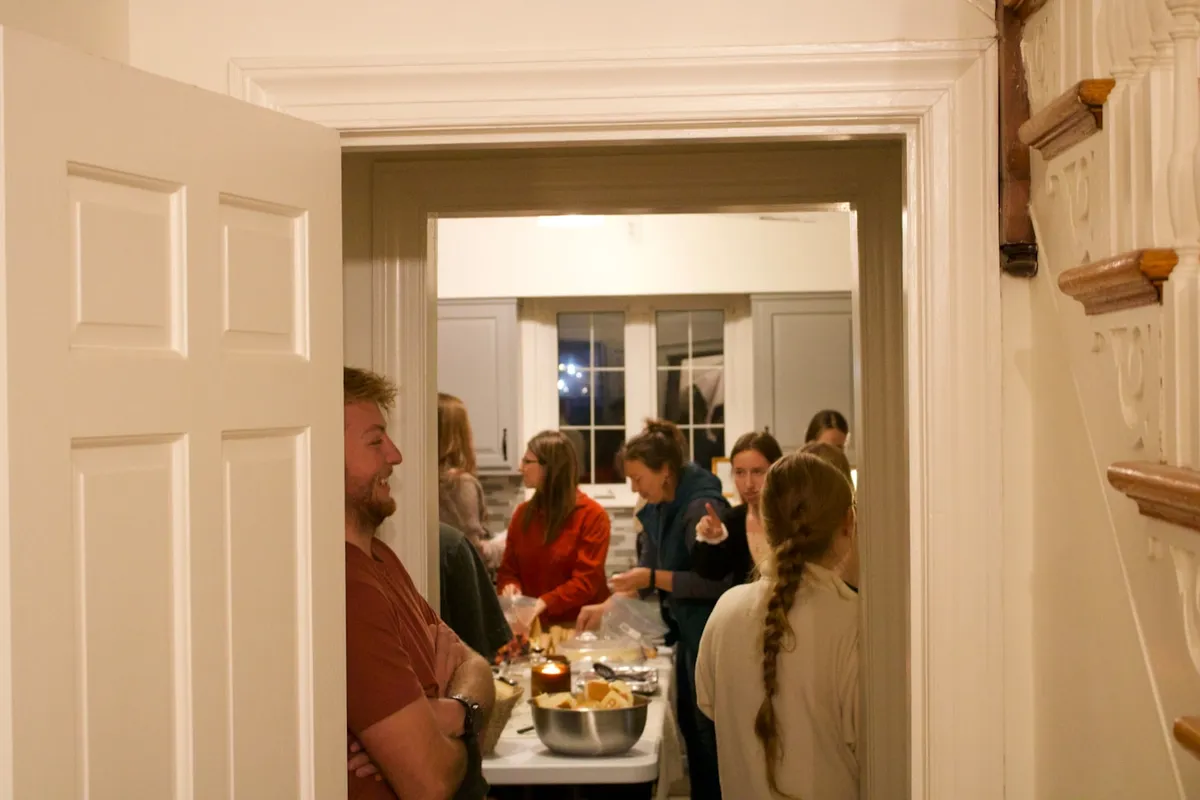
Mismatched Plates
A few weeks ago I went to a friend’s birthday, who has two small kids. While they were still up we had dinner together and played with them on the rug. After eight, once they were down, the apartment got quiet. We lit a few candles, put on quiet music, and pulled out a board game.
At some point during the game I noticed it just felt nice. Authentic. Humane, even. I wasn’t thinking about work or AI or any of the rest of it. I was just there, on a rug, with friends and a candle and a half-played board game, and for the first time in a while my head wasn’t somewhere else.
Then I actually looked around. Mismatched plates and cutlery on the table. Three kinds of glasses because the matching set was already in the dishwasher. The food had been good but nothing fancy, served from the pots it was cooked in. Crayon and felt-tip across about three feet of one wall. Plastic dinosaurs under the radiator. A train track curving across the floor with a piece missing in the middle.
I’d come in expecting an evening that would be slightly compromised by the kids being there. Instead it was the most relaxing dinner I’d been to in months.
Nothing about it felt staged. We sat on the floor for the first part. My friend was in a hoodie. His partner sat on the rug between trips to the kids’ room and didn’t apologize for the state of the apartment, which I kept noticing because at every other dinner I’d been to recently, the host had apologized for something.
What I felt the whole evening, and I’ve been thinking about it for weeks since, was that I was inside a room where someone actually lived. Not a room arranged for me to be in. A room that, if I hadn’t shown up, would have looked roughly the same. And it turned out that’s the difference.
What we’ve made hosting mean
We’ve inflated it. Only about 4% of Americans host or attend a social event on a given weekend day, according to Derek Thompson’s read of the U.S. Bureau of Labor Statistics’ American Time Use Survey appendix tables. The number is staggering for how low it is, and the explanation isn’t laziness or lost interest. The explanation, I think, is that we’ve quietly raised the price of admission to the point where most of us can’t pay it.
Place cards for six. A floral centerpiece tall enough that you have to lean sideways to see who’s across from you. A tablescape that took two hours to set. Three courses, the third of which nobody finishes. The host trapped in the kitchen for the first forty minutes plating, while the guests stand around with drinks they don’t know what to do with.
I have hosted this version of dinner. About a year ago, for my own birthday, I cooked a five-course meal I’d planned for a week. I staged three rooms: drinks in the kitchen, the meal in the dining room, dessert in the living room. Three moods, like a small theater production with set changes. By the time the third course landed I was tired in a way that surprised me. I remember sitting down and registering that I was barely listening to the conversation at my own table because I was halfway up again, mentally, to plate the fourth. My guests had a fine time. But the room migrations didn’t change anything. People stayed in their seats.
What I noticed afterward was that nobody could remember the courses. They could remember a story someone had told. They remembered the moment two friends who’d just met realized they’d grown up two streets apart. They couldn’t tell you what was on the third plate.
What the food carries, and what it doesn’t
There’s actual research on this, and what’s interesting is how unromantic it is. A piece in Popular Science reviewing the science of hosting points out that abundance, more or less reliably, makes guests less happy than restraint. People eat more when there’s more food in front of them, and at the end of an oversupplied evening they aren’t warm and full, just slightly nauseous. The same article cites research that even heavy cutlery makes guests rate the same meal as more enjoyable than light cutlery: what changes the experience of food at a table is rarely the food itself. It’s the texture of the room. The lighting. Whether the host is sitting with you or behind you in the kitchen.
The single piece of advice that stuck with me was deceptively small: lower the lights to 30 or 40% by dinnertime, and switch from overhead to lamps and candles. Not because it’s romantic, but because overhead light at full strength makes people look exhausted, and an exhausted-looking room makes the guests, by some quiet contagion, behave like exhausted people.
You can spend two days on a tablescape and undo all of it by leaving the kitchen pendant on.
The case for the staged version
I want to be honest about the counterargument, because the case for elaborate hosting isn’t silly. For some people, cooking a long meal is the love language. The five-hour braise, the homemade pasta, the careful platings: these aren’t performance, they’re a way of saying I thought about you all afternoon. Stripping that out in the name of “casual” misses something real. There are guests who feel taken care of precisely because the host went to the trouble. I’ve been on both sides of it.
What I’d say back, after my own five-course evening, is that the trouble is worth it as long as the host can still sit at the meal, and stops being worth it the moment they can’t. The line isn’t effort vs. no effort. It’s effort that lets you sit down vs. effort that keeps you standing up. I hadn’t noticed that line until I crossed it.
What we tried next
A few months later, my partner and I hosted again. We still cared about how the table looked. We arranged flowers and chose linen napkins and a candle that didn’t fight the food. But we cooked one main and two sides, both prepped the day before. We poured drinks within sixty seconds of people arriving. We sat down with them.
What I remember is not the food, which was fine, and not the table, which was nice. I remember that someone updated us on a hard year his sister was having. Someone else asked the kind of question most dinners don’t get to. By the time dessert was on the table, no one had checked their phone in an hour, and nobody, including me, had stood up. The candle was a third of the way down. The plates we’d cared about so much were stacked in a wobbly pile on the counter and nobody had noticed when that happened.
The staging, at most, had set the tone and then politely gotten out of the way.
The smaller, quieter point
We tend to think of the dinner party as a thing you produce for guests, like a small magazine issue. The food is the cover story, the table is the layout, the music is the soundtrack. That whole frame is borrowed from somewhere: Pinterest, glossy magazines, the tableware industry, a particular kind of Instagram aesthetic. It puts the host in the wrong job. It puts them in the role of editor instead of friend.
The friend’s birthday with the kids and the wall full of crayon worked because nothing in the evening was edited. We were inside a living room, not on a stage. A small enough group for one conversation. The pieces of the evening fit because they hadn’t been arranged. They had just been allowed.
I think most of us are starving for that: a room that feels like someone lives in it. A host already sitting at the table when we arrive. A candle on the windowsill instead of on the table because the toddler-factor demanded it, and everyone in the room knowing why and laughing about it.
What I’m sitting with
When I think about the next time we host, the question I keep arriving at isn’t what should I cook? It’s what do I need to leave undone for me to actually be in the room? The throw blanket on the couch. The mismatched glasses. The pile of mail on the kitchen counter that I would have hidden a year ago and now I think I might just leave there.
If only 4% of us are hosting on a given weekend, the missing 96% are standing in their kitchens looking at a Pinterest board and quietly deciding, again, that this isn’t the weekend. The cost of admission has been set wrong. Most of us know it, which is why we keep not paying.
The dinner parties people come back to look lived-in because someone actually lives there. The host who got it right at my friend’s place last month didn’t get anything especially right. He just didn’t get it wrong by trying too hard.
Hero image by Patrick Marion on Unsplash.
Related Articles

The Thursday Problem
Men aren't losing friends because they won't open up. They're losing the weekly reason to show up. The male friendship crisis is an infrastructure problem, not a character one.
April 19, 2026
How to Make Friends as an Adult
Adult friendship isn't a personality problem. It's an infrastructure problem, and the infrastructure is quietly coming back. Where to look, how to show up, and what to do when the first three weeks feel awkward.
April 20, 2026
Why Your Best Friendships Have a Rhythm
The friendships that survive adult life share one trait: regularity. Research shows why a weekly cadence matters more than grand gestures.
April 16, 2026