Why Friendships in Big Cities Don't Stick
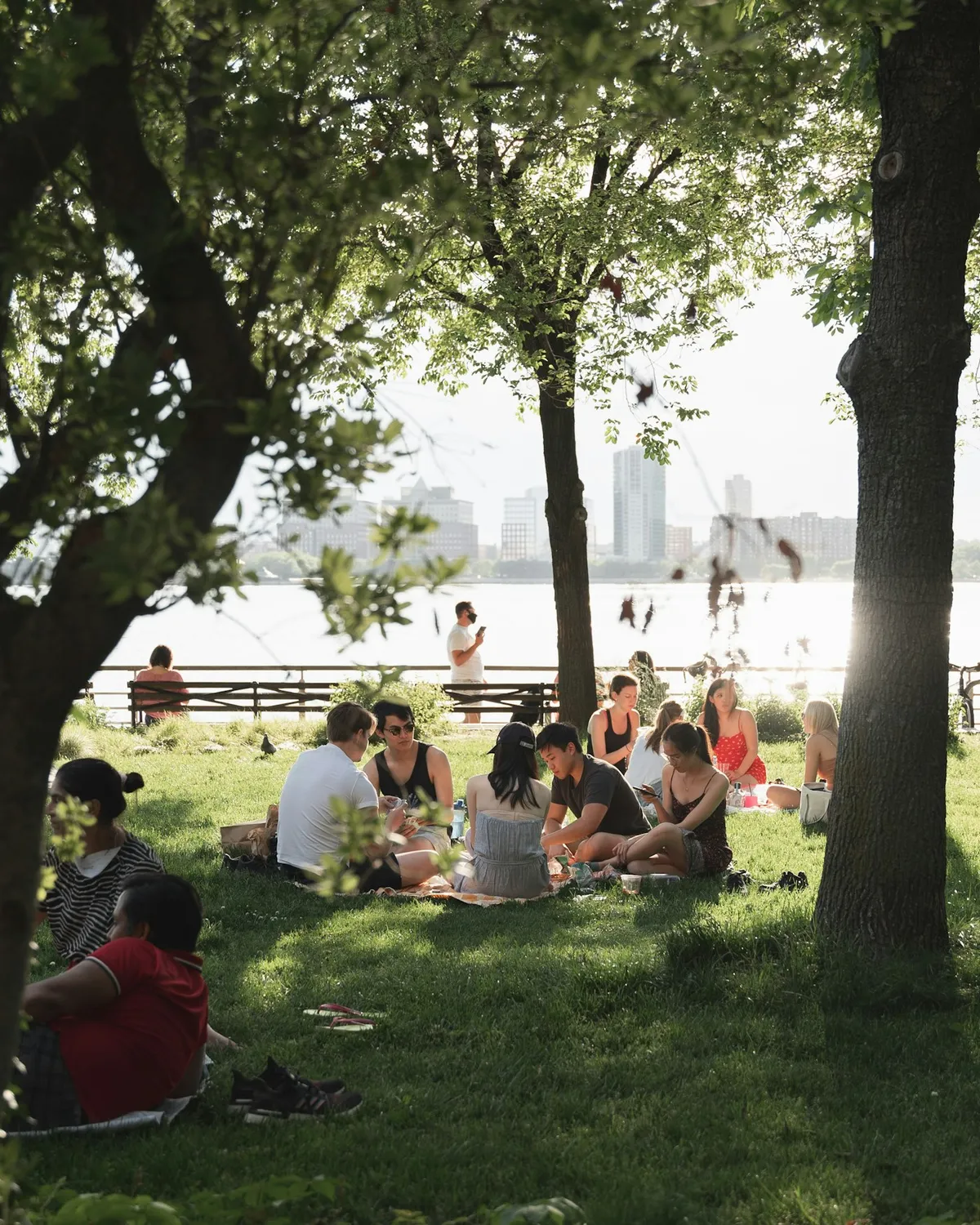
When I was a student in Dresden, a normal day looked something like this. A lecture in the morning, a practical in the afternoon, sports somewhere in between, with gaps wedged between all of it where I didn’t have to be anywhere in particular. In those gaps, almost without thinking about it, I’d walk over to a friend’s dormitory or to the library or down to the cafeteria and there was always someone there. I’d ask what they were doing. They’d say something or nothing and we’d go for a run or make pasta in the shared kitchen or sit on the lawn for two hours and not really do anything in particular. Nobody scheduled it. Nobody had to.
The timetable changed every semester, which meant the free hours kept landing next to slightly different people. Friendships rotated a little around it. What didn’t rotate was that the day always had cracks in it and the cracks were where everything social happened. That whole life ran on a single, almost embarrassingly simple fact: most of the people I liked lived within a fifteen-minute walk of where I slept and our gaps lined up.
I moved to Berlin a few years later, took a full-time job and tried to keep living that way. It didn’t work and at first I couldn’t tell why.
Then I moved to Berlin
A few things were different at once.
The first was time. A real job ate the hours that used to be free by default. After work I wanted to play sports, read, cook something that wasn’t pasta, see something of the city. By the time the evening was negotiated against all of that, the loose four-hour window for “drop by Stefan’s, see what’s happening” was simply gone.
The second was geography. Berlin isn’t a campus. To see almost anyone I knew, I had to commit to forty minutes on the U-Bahn and they had to commit to forty minutes back. That changes the texture of seeing each other. You don’t drop in. You schedule. Two people coordinating their calendars two weeks out is a very different kind of friendship than someone sticking their head into a hallway and saying “kitchen?”.
The third was that everyone I met was now in the middle of their own life. Some had been in the city for years and already had the friend they called when something went wrong. Others had moved last month and were still trying to figure out the language. Some were single and had time. Others were partnered or had a kid or were on a visa that might not get renewed. There was no shared shape to default to. We weren’t all doing the same thing in the same way for the same four years anymore.
Adult friendship is shaped differently
It took me longer than it should have to see what this all added up to.
When I was a student, almost everyone in my orbit was running roughly the same software. We were the same age, in the same buildings, with mostly the same obligations and mostly the same scattered free hours between them. The pool of “people I could plausibly become friends with” was enormous, because the cost of trying was nearly zero and we kept being thrown back into the same rooms whether we tried or not.
In adult life, that’s gone in every direction at once. The free hours shrink. Interests fan out: one friend is deep into climbing, another is in a band, another is figuring out where their kid will go to school, another is mostly working. The things you have in common stop being structural and start being specific, which means the pool of people who could actually become a close friend is much smaller than it looks. And on top of that, in a city like Berlin, the people in that smaller pool are themselves moving in and out, taking new jobs, getting visas, getting partnered, leaving. You don’t get to find your people and settle. You have to keep finding them, on purpose, while their lives keep changing under your feet.
The student version of friendship was effortless because the building was doing the work. The adult version requires that you do the work yourself, every week, even when you’re tired and forty minutes is forty minutes.
The 200-hour problem
None of this is really about chemistry. Jeffrey Hall at the University of Kansas put a number on the cost of turning an acquaintance into something deeper: roughly 50 hours of shared time before someone feels like a casual friend, around 90 before they feel like a friend and somewhere near 200 before they count as a close one. The hours have to be reasonably regular. A standing Wednesday for a year does what three intense weekends will not, even if the weekends felt richer in the moment.
Big cities make those hours hard to put together. Robin Dunbar’s research on social networks puts a ceiling on the whole project: about 150 stable relationships in a lifetime, only five of which sit in the inner shell where real intimacy lives. A city like Berlin or London or Lisbon, where people arrive in their twenties and leave somewhere in their thirties, spends that capacity badly. You meet someone good. You start something with a slow Wednesday rhythm. Somewhere short of the 200-hour mark, one of you takes a job in another country or moves in with a partner across town or just gets too busy. You start over with someone new. After enough rounds, the part of you that used to walk into kitchens and ask “want to come?” gets quieter.
The candidates that work in this environment, the ones who actually accumulate hours with you, almost always have built-in repetition. People from work. People who live within walking distance. A band, a climbing gym, a Sunday football game. Anything where the meeting isn’t optional. Friendships with a rhythm survive. Friendships that depend on someone organizing a coffee don’t.
The case for the big city
I don’t want to argue the city into a corner, because that would be wrong.
If I’d stayed in the small town I grew up in, I’d have a different and in some ways enviable thing. I’d still see most of the friends I had at fourteen. They’d know my parents. I’d know theirs. There would be a long history under every conversation, the kind you can’t manufacture in your thirties. That’s a real gift and the city does not give it.
But it has a price and people who only know that version of friendship sometimes don’t see it. In a small town, your friends are the ones you ended up with, not the ones you would have chosen if the room had been bigger. You change a little, but not very much, because the people around you aren’t really changing in a way that forces you to. You stay roughly who you were at seventeen.
A big city does the opposite. There are enough people that you can actually find the ones whose interests, values and shape of curiosity line up with yours, even if those people make up a narrow slice of the population. You meet someone who plays the music you didn’t know existed, someone who reads what you read, someone who’s wrestling with the same question you are. You also meet people who challenge you, push you, disagree with you in ways that are useful, because they came from somewhere completely different. You grow. The cost is that the same freedom that lets you find them also lets them and you, walk away when something gets uncomfortable. Friction in a small town is something you sit with. Friction in a city is something you can route around.
Both versions are real. The city version is harder to start and harder to keep and that’s the trade for the rest of it.
What actually worked for me
I have a healthy circle of friends in Berlin now. It isn’t the size of the one I had as a teenager and it isn’t even the size of my Dresden years. But it’s real, varied, full of people I genuinely like and who genuinely like me back.
It did not happen on its own. I pinged people. I was the one who suggested the dinner, the run, the climbing session, sometimes three or four times before anything turned into a thing. I made an effort to make my team at work more social: drinks after work that I’d organize, a Friday lunch that became a Friday afternoon, a few weekend trips. I started showing up to the same sport every week with people I knew would be there. I built repetition into my life on purpose, because the city was not going to build it for me.
The shape of what I built is smaller and more deliberate than student life ever was. It also looks different from the friend group I grew up with: people from different countries, different industries, different ages, who chose me as much as I chose them.
Why these friendships go deeper
What I didn’t expect, when I was missing the dorm version, is that what I was slowly building in Berlin would end up better than what I’d had before.
In Dresden, we mostly hung out. We did things together because we were available and bored. The conversations were good, but we were eighteen, twenty, twenty-two. There wasn’t yet that much weight to talk about. Now, the friends I see for two hours on a Wednesday have spent the rest of the week running their own life. They have a partner, a job they care about, a family back home, a real question they’re sitting with. I do too. When we meet, we’re not killing time together. We’re comparing notes on what we’re each becoming.
I think this is just what adult friendship is meant to be. You have your own life. You have or are building your own family. The friends are not there to fill a hallway anymore. They give you a perspective you couldn’t generate from inside your own life. Someone to think with, someone to argue with, someone to disagree with on something specific without it becoming a problem. You don’t need to be in their pocket. You meet on the things you actually share, you let them go back to their world afterwards and they let you go back to yours.
Maybe I’m saying this because this is the season of life I’m in and I genuinely prefer it to the going-out, nothing-to-do version of student years. But I don’t think I’d take Dresden back even if I could. The friendships I have now do something the friendships I had then never had to.
The thing that survives the distance
Even with all of this effort, the calendar still has limits. Some of the people I’m closest to in Berlin I see once a month, sometimes once every six weeks. Some of the people I’m closest to from my Dresden years live in three different countries and I’m lucky if we sit in the same room twice a year. None of that is fixable by trying harder.
Almost everyone I’m still actually close to has one structural feature in common and it isn’t how often we manage to meet in person. It’s that, somewhere along the way, we built a small repeating thing that didn’t depend on being in the same place. A monthly dinner that has now survived three of us moving to other countries. A weekly call between four people that started as a pandemic accident and never stopped.
This is, in a fairly direct way, why I built Runde. I needed something that kept my friendships warm in between the times we could actually meet. A small private circle, one weekly question, an answer from each person in their own time, plus a quiet record of the last time we were together so I notice when too long has gone by. Nothing fancy. The point is that the thread between us stays alive even when the calendar can’t keep up, even when one of us is in Berlin and one of us is in Lisbon and one of us is six time zones away. I use it every week with my own people. The friendships in it have gotten more present, even though the distances haven’t changed at all.
What I’d tell my younger self at the airport
If I could talk to the version of me who stepped off the plane in Berlin with a suitcase, I’d tell him this. The dorm isn’t coming back and that’s fine. Friendship will be slower, more deliberate and harder to start than it was at twenty-one. The shape that ends up working will look almost embarrassingly small from the outside. Four people. One Sunday. A question that comes around again. Maybe six. Maybe eight, on a good year.
It will also be the best version he’s ever had.
Hero image by Mason Dahl on Unsplash.
Related Articles

The Thursday Problem
Men aren't losing friends because they won't open up. They're losing the weekly reason to show up. The male friendship crisis is an infrastructure problem, not a character one.
April 19, 2026
The Friendship Recession Nobody Warned Us About
What the friendship recession is, why adults have fewer close friends than at any point in 30 years and what the research says about why it's still getting worse.
April 8, 2026
How to Make Friends as an Adult
Adult friendship isn't a personality problem. It's an infrastructure problem and the infrastructure is quietly coming back. Where to look, how to show up and what to do when the first three weeks feel awkward.
April 20, 2026