
What a Friendship App Should Actually Do
We opened our phone this morning to see what our friends were up to. We saw nineteen things and heard from no one. There was a story from our college roommate, a reel of our cousin’s toddler in a banana costume, a workout selfie from the guy from our first job. We tapped through it, smiled and put the phone down without exchanging a single word with any of these people. It is hard to call that catching up.
That is the strange territory most “social” apps live in now. They use the language of friendship — add friend, friend request, see what your friends are up to — but the experience of using them has very little to do with being a friend. We watch our friends. We rarely speak to them.
The word “friend” has been doing strange work
The problem is not that these apps exist. We need to say that clearly, because the conversation around social media has gotten so reflexively negative that any defense sounds naive. Instagram lets us see our cousin’s baby twelve hundred miles away. TikTok makes us laugh on a Tuesday night when nothing else is going to. The group chat with our siblings is, for many of us, the most reliable thread of connection we have. These tools do real things for real people.
What they don’t do, despite the labels, is help us be friends. They were built to win the session. Every product decision flows from that single goal: the autoplay, the streak, the red badge, the algorithm that learns when our attention is most pliable. Tristan Harris and the team at the Center for Humane Technology have spent years documenting how these mechanics borrow from gambling psychology rather than from any model of human relationships. The design is doing exactly what it was designed to do.
What we lose when the design forgets us
The cost shows up in the data and in the texture of ordinary life. The number of American adults with no close friends has quadrupled since 1990, even as our messaging tools have multiplied. A 2023 NIH review connected heavy use of social platforms to measurable increases in anxiety, depression and sleep disruption. Stanford’s Anna Lembke has described the pattern by which heavy use of these apps pushes the brain into a dopamine-deficit state, where the rest of life starts to feel a little dimmer than it used to.
The subtler harm is what scrolling does to our patience for the slower thing. A real conversation moves at the pace of a real conversation, which is much slower than a feed. After an hour of short videos, the friend who finally calls feels strangely demanding. We pick up. We are present, sort of. We are also still half-tuned to the dopamine drip that ended ten seconds ago. The bandwidth a friendship needs is exactly the bandwidth the algorithm just spent.
The contradiction we keep ignoring
The apps with the word “friend” in their copy are mostly the worst place to actually be a friend. The ones that helped a generation feel less alone in the early 2010s are the same ones quietly hollowing out the muscle of close friendship in the 2020s. It is not because the engineers set out to do that. It is because the business model and the design are aligned around a different goal and friendship is what gets traded away when those two things win.
A friendship app that took friendship as its actual job would look almost nothing like the apps we currently use to stay in touch. It would be uninterested in our attention. It would have no feed, because feeds require content and friendship is not content. It would not optimize for daily opens, because real friendship runs on a slower clock. Sociologists have long shown that the friendships that survive adult life are the ones with a recurring cadence, not the ones with the most messages.
What it would do instead
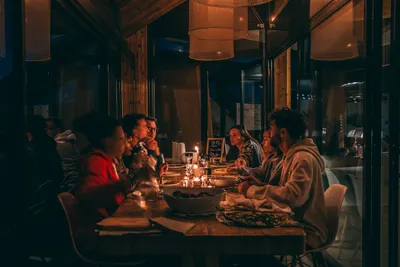
It would put one good question in front of a small group of people who already know each other and ask them to write a real answer instead of tapping an emoji. Each answer would stay private until everyone had written theirs, so no one’s reflection was shaped by seeing someone else’s. The answers would unlock together, the way a dinner table does and the conversation could go wherever it wanted. When the conversation faded, the app would close and leave the group alone until the same time next week.
This is some of what we are trying to build with Runde. We are not certain we have the shape exactly right yet and we are aware that “an app to fix what apps broke” sounds like a punchline. The honest version is that we wanted to see what software could feel like if it served the relationship instead of the session — not as a productivity hack, but as an experiment in giving our friends a small, steady place to actually meet.
What stays after the app closes
A friendship app will not save anyone’s friendships. The friendships are saved by the people who keep showing up for each other, in the ways they always have: the standing walk on Sunday, the call on the drive home, the dinner that gets put on the calendar two months out. The most any piece of software can do is make showing up a little easier and a little more inevitable.
That might be the test, in the end. After we close the app, what is left in the room? If the answer is a slightly better conversation with a person we love, the app did its job. If the answer is the urge to open something else, it did not.
Hero image by Gabe Pierce on Unsplash.
Related Articles
Pay for the Room, Not the Seat
Software almost always charges one person for a private upgrade, but the things worth paying for in a group are jointly held. A reflection on why the unit of payment should be the relationship, not the individual.
June 12, 2026
Adding Stories: Five Updates a Week
I added stories to a friendship app, then spent longer than I'd admit trying not to copy the version everyone already has. Here's what I changed and the objection I couldn't engineer away.
June 6, 2026
On Streaks and Admitting We Were a Little Wrong
We wrote two posts arguing against streaks. We're adding one anyway. A reflection on the difference between an engagement trick and a small, honest nudge — and where we tried to draw the line.
May 1, 2026